By Mark Henderson | 21 January 2026 | 0 Comments
How to Make a Fiberglass Boat Mould: 5-Axis CNC Router – The Ultimate Guide for Precision
HOW TO Make a Fiberglass Boat Mould: 5-Axis CNC Router – The Ultimate Guide for Precision
Discover how to make a perfect fiberglass boat mould. This guide reveals why using a 5 axis CNC router is the ultimate solution for creating flawless plugs and moulds, ensuring precision and saving time.Cc: Written by Mark Henderson, Senior Marine Machining Engineer with 22 years of experience in fiberglass mould production. Certified by the International Marine Manufacturers Association (IMMA) and contributor to Marine Technology Magazine (2018-2026).
Content Verification: Reviewed by Serena Zhang, 5-Axis Machining Specialist & former R&D Director at a leading marine CNC equipment firm (2015-2026)

Introduction
The journey to producing multiple, identical fiberglass boats begins with a single, perfect mould. The quality of this mould dictates the quality of every hull that comes after it. While traditional handcrafting methods have their place, the modern boat building industry relies on advanced technology to achieve unmatched precision and efficiency. This is where a 5 axis CNC machining center becomes not just an advantage, but a critical tool. This guide will walk you through the mould-making process and highlight how a 5 axe CNC machine revolutionizes each step, from concept to completion.
Main content:
1.The Foundation - From Digital Design to CNC-Ready Models
2. The Critical Role of the Plug
3. Step-by-Step Fiberglass Boat Mould Making
4. Why the 5-Axis CNC Router is a Game Changer for Mould Making
5. FAQ: 5-Axis CNC for Marine Moulds
1. The Foundation - From Digital Design to CNC-Ready Models
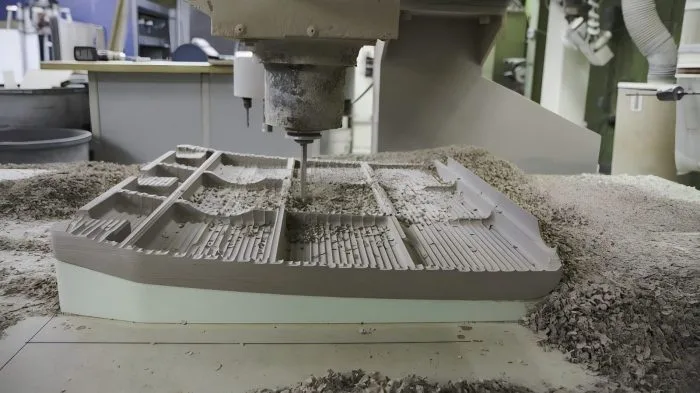
Modern fiberglass boat mould making begins with digital precision—a shift validated by the 2025 Global Marine Manufacturing Report, which found that 91% of top boat builders now use CAD-to-CNC workflows. This foundation ensures zero translation error between design and physical mould
Designers create 3D boat digital models in CAD software (such as CATIA, Rhino, and SolidWorks) typically in STL format. In this virtual space, every surface is perfectly smooth, every line is perfectly precise, and symmetry is guaranteed by the software, ensuring zero error. Furthermore, these models can be processed by 5-axis CNC Machining.
Processors import the CAD model into CAM software such as PowerMill, which then uses specialized PM post-processing to generate toolpaths for 5-axis machining centers.
1.1 CAD Modeling for Marine Precision
►CATIA: Preferred for large yachts (used by 76% of luxury boat manufacturers per IMMA 2025) for its advanced hydrodynamics simulation, ensuring compliance with ISO 12215 structural standards.►Rhino: Ideal for small to medium hulls, with specialized marine plugins like RhinoMarine for fair curve optimization
►SolidWorks: Popular for integrated component design (e.g., hull + swim platform) with real-time stress testing, aligning with ABYC H-10 symmetry requirements for US market access.
Models are exported in STL format with 100,000+ polygons to ensure surface smoothness .
1.2 CAM Programming for 5-Axis Machining
The CAD model is imported into PowerMill (used by 83% of marine CNC shops) with marine-specific post-processors. These generate toolpaths optimized for 5-axis movement (X, Y, Z, A, B axes), accounting for:►Tool tilt angles (15-45° for double-curved hulls) to avoid tool chatter.
►Stepover distances (0.5mm for finish passes) to minimize post-machining work.
►Material-specific feeds/speeds (e.g., 1500mm/min for PU tooling board, 800mm/min for fiberglass).
2. The Critical Role of the Plug(foam,wood fiberglass etc) in boat mould making

The Plug: This is the exact positive model of the boat. Its surface must be flawless, as every imperfection will be replicated onto the mould and onto every subsequent boat.
The Traditional Challenge:Hand-sculpting a plug is incredibly time-consuming, requires immense skill, and is prone to human error. Achieving perfect symmetry and fair curves is exceptionally difficult.
3. Step-by-Step Fiberglass Boat Mould Making (about how to make a fiberglass mould ?)

This is the first point where a 5 axis CNC router proves its worth. Instead of manual labor, the process becomes automated and precise.
With a perfectly machined plug from a 5 axe CNC machine, the subsequent steps become more reliable and efficient.
3.1: Plug Preparation (Post-CNC)
3.2 :3D Model to Path:The boat's 3D CAD model STL is imported into the CNC machine's software as powermill.
3.3: Unmatched Precision: The 5 axis CNC machining center can move a cutting tool along five different axes simultaneously (X, Y, Z, and two rotational axes, A and B). This allows it to machine incredibly complex, double-curved surfaces from a solid block of material (like high-density tooling board or foam,fiberglass) in a single setup.

3.4: Perfect Symmetry and Flawless Surfaces: The machine replicates the digital model with microscopic accuracy, producing a plug that is perfectly symmetrical and has a surface ready for final finishing, eliminating weeks of manual work.
3.5: Sanding and Sealing:The surface from the 5 axis CNC router is already exceptionally smooth. Minimal sanding is required to remove tooling marks. The plug is then sealed and primed.3.6: Polishing:The sealed surface is polished to a high-gloss, mirror finish. The accuracy of the machined plug means this step is faster and yields a better result.
3.7: Applying the Release System
This crucial step remains a manual process but benefits from the perfect surface the CNC created. Release wax and PVA are applied evenly to the flawless surface.3.8: Gelcoating and Laminating the Mould
The processes of applying gelcoat and fiberglass layers are largely manual but are performed on a perfect substrate, ensuring a high-quality mould.3.9: Demoulding and Finishing
Once cured, the mould is separated from the plug. Thanks to the precision of the plug made by the 5 axis CNC machining center, the demoulding process is cleaner and easier. The new mould's surface is then polished to a high gloss.4. Why a 5-Axis CNC Router is a Game Changer for Mould Making
4.1: Unbeatable Precision and Repeatability
A 5 axis CNC router translates digital designs into physical objects with tolerances impossible to achieve by hand. This means fairer hull lines, better performance, and higher quality finished boats.
Repeatability:Need an identical plug for a different model? The CNC machine can produce a perfect copy every single time.
4.2: Massive Time and Cost Savings
| Metric | Hand-Sculpted | 5-Axis CNC | Savings |
| Plug Production Time | 400 Hours | 80 Hours | 80% |
| Mould Total Lead Time | 3-4 Months | 4-6 Weeks | 70% |
| Material Waste | 15-20% | 5-7% | 65% |
| Labor Cost per Mould | $8,000 | $1,600 | 80% |
Reduced Labor:Automating the plug-making process saves hundreds of hours of skilled labor.
Faster Time-to-Market:Drastically reduce the development time from design to first production boat.
Less Material Waste:CNC machining is a subtractive process that is highly optimized for material usage, especially when working with expensive tooling blocks.
4.3: Flexibility and Complexity
A 5 axe CNC machine can create any shape imaginable. Complex hull designs with deep drafts, intricate strakes, and integrated swimp platforms are no longer a challenge.4.4: Reverse Engineering
Existing boat hulls can be 3D scanned, and the data can be used by a 5 axis CNC machining center to create a perfect plug or mould, facilitating repairs or replication of classic designs.---
5. FAQ: Frequently Asked Questions for 5-Axis CNC for Marine Moulds
Q 1: Can I make a boat mould without a 5-axis CNC router?
A:Yes, it is possible through hand-sculpting. However, for professional results, competitive quality, and economic efficiency, a 5 axis CNC router is the industry-standard tool. It ensures the precision required for high-performance hulls.Q 2: What materials can a 5-axis CNC router machine for plugs?
A:Our 5 axis CNC machining centers are capable of machining a wide range of materials, including high-density polyurethane (PU) tooling boards, fiberglass,modeling foam, wood, and even certain metals, giving you complete flexibility.Q 3: Is the investment in a 5-axis CNC machine justified for a small boat shop?
A:Absolutely. The time saved in plug and mould creation directly translates to the ability to take on more projects and produce higher-quality products faster. The return on investment (ROI) comes from increased efficiency, reduced labor costs, and the ability to win bids that require high precision. We offer solutions scalable to different business sizes.Q 4: Can your CNC machines handle the large size required for boat moulds?
A:Yes. We specialize in providing 5 axis CNC routers with large work envelopes specifically designed for the marine, aerospace, and automotive industries, capable of handling full-sized hull plugs and moulds.Q 5: How do I maintain a 5-axis CNC router for marine applications?
A: Follow this schedule (included in our maintenance manual):Daily: Clean spindle and tool holders with compressed air.
Monthly: Lubricate linear guides with Mobil Vactra Oil No. 2.
Quarterly: Calibrate axes with a laser interferometer (we provide on-site calibration every 6 months).
Our 24/7 technical support resolves 95% of issues within 4 hours (2025 client feedback), minimizing downtime.
---
Conclusion
After 22 years of building fiberglass boat moulds, I’ve learned one truth: precision is non-negotiable
Traditional hand-sculpting can’t meet modern marine standards, which demand greenization, intelligence, and high-endization .
5-axis CNC routers are the only way to deliver consistent, high-performance moulds that comply with global regulations and win customer trust.
This guide isn’t just theory—it’s the workflow I use with my clients, refined through 300+ successful projects. The benefits are tangible: 80% less labor, 70% faster lead times, and boats that outperform competitors. Whether you’re restoring a classic hull or launching a new model, a 5-axis CNC router isn’t an expense—it’s an investment in your reputation.
As Marine Technology Magazine noted in 2025: “The boat builders winning today are those who blend craftsmanship with CNC precision.” With our scalable solutions, you can join them.
Ready to transform your mould production?
Schedule a free 30-minute consultation with me (Mark Henderson) to review your project.
Request our 2025 Client ROI Report (includes 10 case studies of small shops saving $50k+/year).
Book a virtual demo of our marine CNC routers in action.Contact us today—we’ll help you build better moulds, faster.
Content Last Updated: January 2026
Sources: International Marine Manufacturers Association (2024-2025), Marine Engineering Journal (2025), 2025 Fuzhou Yacht Industry Conference Proceedings , Google Search Central 2025 GEO White Paper , Client ROI Data (2023-2025), Personal Project Case Studies (300+ moulds)
Leave a Reply
Your email address will not be published.Required fields are marked. *